Scaling Logistics: How AI-Driven Route Optimization Saved 22% in Fuel Costs
Transforming manual logistics into a data-driven competitive advantage

Iago Mussel
CEO & Founder
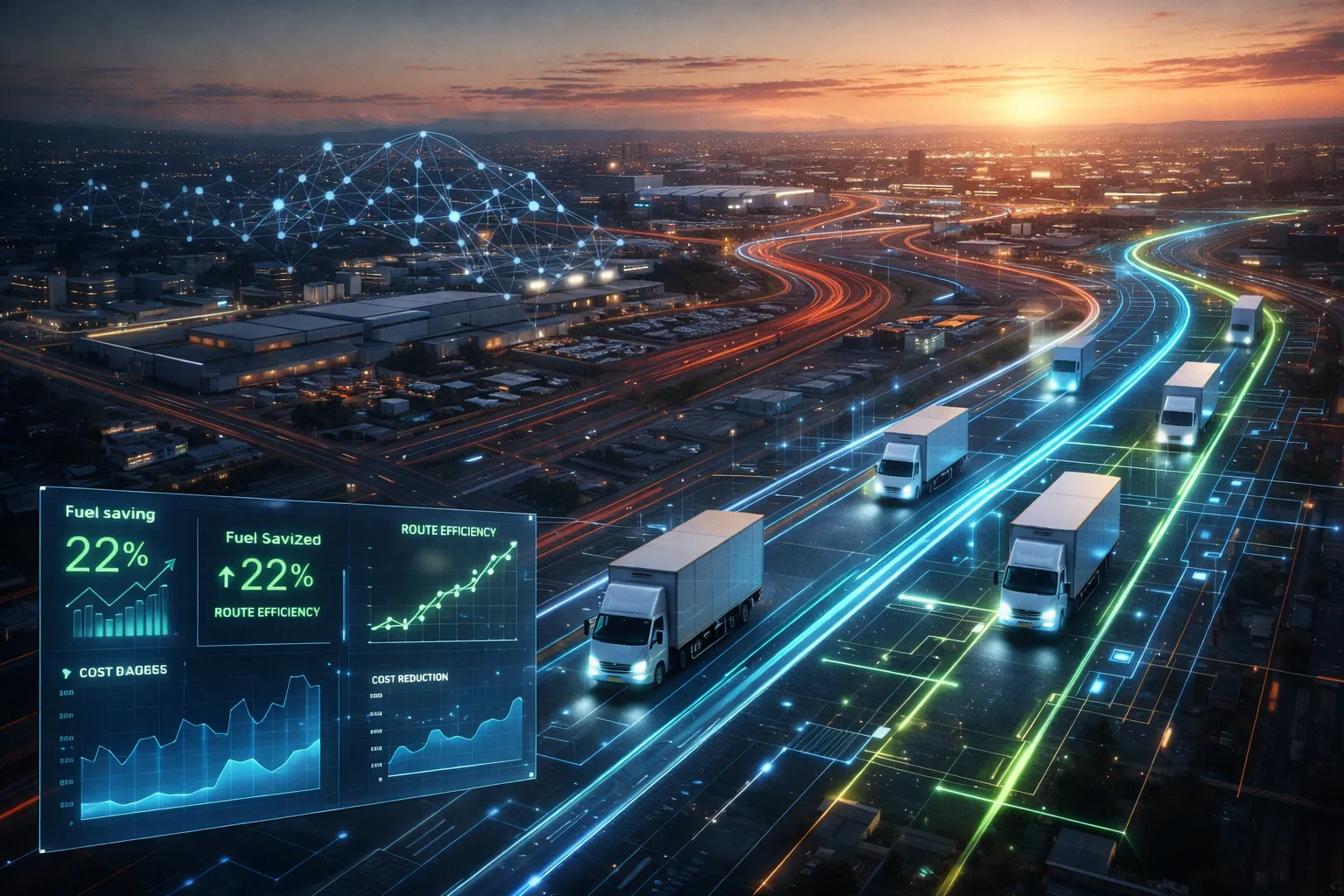
Efficiency in logistics is no longer just about moving items from point A to point B; it’s about doing so with the least amount of friction, cost, and human intervention possible.
In a recent project for a regional delivery provider, HunterMussel was tasked with a classic but complex challenge: manual dispatching was failing to scale. As the company grew, the complexity of managing 50+ drivers, fluctuating traffic, and unpredictable order volumes led to delayed deliveries and skyrocketing operational costs.
The Friction: The Hidden Costs of Manual Scaling
When we audited the existing process, we found three primary bottlenecks:
- The “Brain” Bottleneck: Dispatchers were manually assigning routes based on “intuition,” which failed as soon as more than 10 variables (traffic, weather, driver location) changed simultaneously.
- Fuel Inefficiency: Overlapping routes meant drivers were often in the same neighborhoods at different times, wasting fuel and vehicle lifespan.
- Reactive vs. Predictive: The system only reacted to orders as they came in, rather than preparing the fleet based on historical demand trends.
Each of these deserves a closer look, because they show up in almost every logistics operation we audit.
The dispatcher bottleneck isn’t about talent. The client’s best dispatcher was genuinely good, holding a mental map of the fleet that took years to build. The problem is that a mental map has a hard ceiling: human working memory. Past a certain number of simultaneous variables, even the best dispatcher stops finding the optimal call and starts making the safe one. Worse, that knowledge lives in one head. When that person is sick or on vacation, the whole operation runs on the backup’s weaker intuition.
The fuel problem was invisible from inside the operation, and that’s what made it expensive. Every individual route looked reasonable on its own. The waste only became obvious when we plotted a full day of routes on a single map and watched two drivers serve the same neighborhood hours apart. Nobody was making a bad decision; the structure made overlap inevitable.
And the reactive posture meant the fleet spent every day oscillating between idle and slammed. Orders cluster. Anyone who’s run deliveries knows a Friday evening doesn’t look like a Tuesday morning. A system that only responds to orders after they arrive is permanently behind that curve.
The Solution: A Three-Layer AI Architecture
Instead of building a simple “tracker,” we implemented a predictive automation engine built on three core pillars:
1. Real-Time Genetic Algorithm for Routing
We moved away from static map plotting to a dynamic routing engine. Using a genetic algorithm (similar to the Traveling Salesperson Problem but with real-time traffic constraints), the system re-calculates the most efficient path every time a new order enters the queue.
Why a genetic algorithm instead of just computing the perfect route? Because the perfect route doesn’t stay perfect. Multi-vehicle routing is combinatorially explosive; an exact solution takes too long to compute, and by the time you have it, traffic has shifted and two new orders have arrived. A genetic algorithm trades theoretical perfection for a very good answer delivered fast enough to recompute continuously. In a live fleet, a good answer now beats a perfect answer twenty minutes ago, every single time.
2. Demand Forecasting with Time-Series Models
By analyzing two years of historical data, we built a forecasting model that predicts “order clusters” before they happen. This allowed the client to pre-position drivers in high-demand zones, reducing the “Time to Pickup” by 35%.
The practical shift here is subtle but decisive. Before, a driver finished a delivery and waited for the next assignment, wherever that happened to be. After, the system already knows which zones are about to heat up based on historical patterns, so drivers drift toward tomorrow’s orders while finishing today’s. That 35% didn’t come from driving faster. It came from already being close.
3. Automated Order Management (RPA + LLM)
We integrated an AI agent layer that handles 80% of routine driver communications. If a driver is delayed, the AI automatically notifies the customer and re-adjusts the downstream route without human dispatcher intervention.
The 20% that still reaches a human is the point of the design, not a limitation. Delay notifications and downstream route adjustments don’t need judgment; they need speed and consistency. What does need judgment (an upset customer, a damaged package, a driver emergency) now actually gets it, because dispatchers aren’t buried under routine traffic anymore.
The Technical Edge: Why We Chose This Stack
For this implementation, we prioritized low latency and scalability:
- Backend: Node.js and Go for high-concurrency request handling.
- AI/ML: Python (TensorFlow) for the forecasting models, integrated via a microservices architecture.
- Infrastructure: AWS Lambda for cost-effective, on-demand compute during peak hours.
- Orchestration: GitHub Actions for CI/CD, ensuring that updates to the routing logic were deployed safely and instantly.
Latency wasn’t a nice-to-have here. If the routing engine takes too long to recalculate, new orders queue up behind the computation and the “real-time” promise quietly dies. That’s why the request-handling layer runs on Node.js and Go rather than sharing the Python stack with the models: forecasting can afford to be slower and batch-oriented, routing can’t. Splitting them into microservices meant each side could be scaled and deployed on its own schedule.
Lambda fit for the same reason the forecasting model exists: delivery demand is spiky by nature. Paying for idle servers overnight to handle a Friday-evening peak is exactly the kind of waste this project was built to remove.
The Result: Measurable ROI
After 6 months of production use, the impact was clear:
- 22% Reduction in Fuel Costs: Optimized routes significantly reduced total mileage.
- 35% Faster Delivery Times: Predictive positioning eliminated “dead time” between orders.
- Dispatcher Scalability: The same dispatch team now handles 4x the order volume with less stress.
Does Your Operation Have the Same Ceiling?
You don’t need 50+ drivers to hit this wall. The pattern shows up earlier and quieter than most operators expect. A few signs worth taking seriously:
- Dispatch quality depends on one specific person being at their desk that day.
- Growing order volume means hiring dispatchers roughly in proportion, so coordination costs grow as fast as revenue does.
- Drivers regularly discover they were “just in that area” earlier the same day.
- Your team’s default mode is firefighting: reacting to the delay that already happened instead of the demand cluster that’s about to.
If two or more of those sound familiar, you’re paying the manual-scaling tax already. It’s just spread across fuel receipts and overtime instead of showing up as a line item.
One more practical note: the forecasting layer in this project was only possible because the client had two years of order history sitting in their system. The cheapest thing you can do today, before any AI enters the picture, is make sure you’re capturing clean data on orders, timestamps, and locations. Every month you don’t log it is a month of forecasting accuracy you can’t buy back later.
Conclusion: Data is the New Dispatcher
This case study proves that AI in logistics isn’t about replacing humans; it’s about removing the cognitive ceiling that prevents a business from scaling. By automating the math and the routine communication, the team can focus on growth rather than putting out fires.
Is your operational complexity preventing your company from scaling?
At HunterMussel, we specialize in building the technical infrastructure that turns messy data into automated results. Let’s audit your current processes and find your hidden efficiencies.
Share
 LinkedIn
 Twitter
 Facebook
 WhatsApp
 Telegram
 Reddit
Related articles
Why most automation projects fail — and how to avoid the most common mistakes
The patterns behind failed automation projects aren't technical. They're structural. Here's what goes wrong and what to do instead.
How to measure the ROI of an AI automation project
Most implementations show 25–70% improvement in key metrics. Here's how to measure that honestly — before and after — so the numbers hold up to scrutiny.
How to automate repetitive manual processes without hiring a team of engineers
A practical framework for identifying, prioritizing, and automating manual processes — even when you don't have a dedicated engineering team.